Momentum Hunter LLC
Momentum Hunter LLC
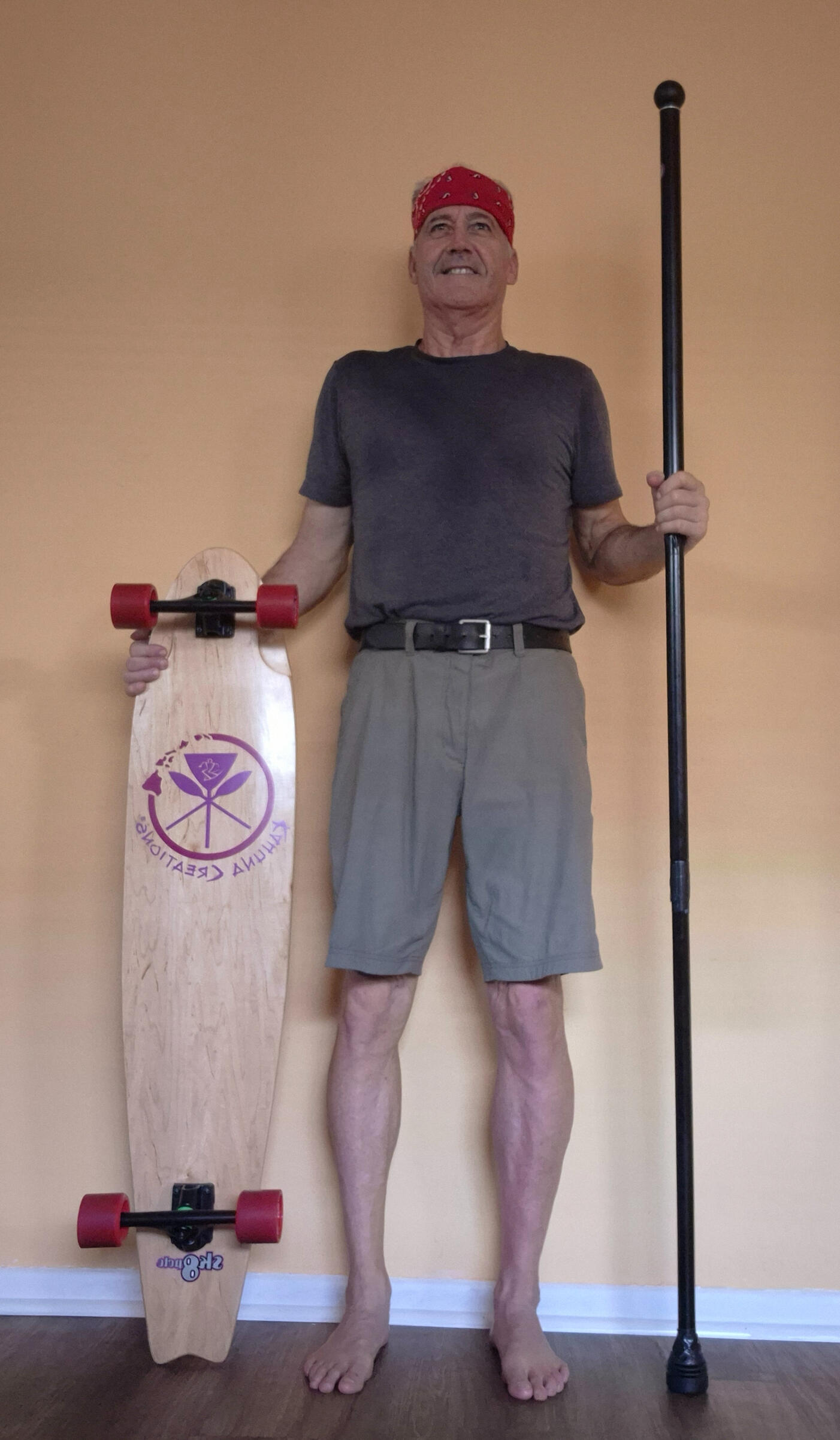
The Joyful Wayfarer
Independent retail trader and founder of Momentum Hunter LLC who manages capital while traveling as a digital nomad. With 23 years of trading experience, the approach is both mechanical and discretionary. Several momentum swing trading methods based on trend are utilized as market conditions allow. Stage 2 markups and Stage 4 markdowns are the primary backdrop using a disciplined 1% risk rule per trade. The past 4 years have ably demonstrated that a self-funded account can grow substantially through disciplined focus--not luck. These blueprints represent the exact logic used to gather profits while on the road.
Life beyond the charts. Travel adventure photo-essays and how-to guides written under two pen names: Pierre De Moin and Tristan Jenevieve.
2007: The Year I Doubled My Account And (Why I Walked Away)2007 was a landmark year. It was a "sea change" in my life, marking the intersection of a 25-year career in ornamental plastering and my emergence as a retail trader.
At the time, I was a lead foreman on the Ty Warner Estate in Santa Barbara, overseeing the interior of a main house so massive it defied logic. My final project was a faceted dome ceiling in the master bathroom—a structure resting on ornate arched grills and stone columns. The project manager estimated the total cost of the estate anywhere from 125 to $250 million by construction completion.Engineering Under Pressure: The 400 lb. LessonThe logistics were the stuff of nightmares. Each faceted panel weighed 400 lbs. My biggest fear was the safety of the crew. If a panel became unwieldy during the hoist, it would crash onto the carpenters and plumbers working below.
I had to design a custom block-and-tackle system to augment the hydraulic lift. We had to "dry-fit" the entire dome—hoisting, mounting, adjusting, and removing all eight panels—before the final installation.
The Trading Parallel: That project taught me that high-stakes success isn't about "luck"; it’s about meticulous preparation and risk mitigation. If you haven't "dry-fitted" your trading plan, the market will eventually drop a 400 lb. panel on your account.Transitioning to the Screen: 100% Growth in 2007While managing that $8 million bathroom installation, I was also "engineering" my brokerage account. By the end of 2007, I had achieved 100% account growth. I did this while working full-time, placing trades on a cell phone during lunch breaks or at the end of day. My strategy was disciplined and focused.
The Universe: I strictly traded the IBD 100 Top Growth Stocks.
The Setup: I waited for elite stocks to pull back and "bounce" off the 50-day Simple Moving Average (SMA).
The Logic: The 50 SMA is the institutional line of demarcation. If the "big money" is defending that line, I want to be right there with them.2008: The Bear Market Reality CheckConfident from my 2007 success, I retired from plastering to trade full-time in 2008. I signed up for a day trading futures course from RS of Houston, which was marketed as "The last trading course you'll ever need." Then, the subprime financial collapse arrived.
I spent 2008 watching the market devour accounts. I was learning a complex futures methodology involving four moving averages and weekly pivot points. I was mentored by two opposites:
The Perma-Bear-- Who viewed a 12-trade losing streak as a "slump" he could power through.
The Perfectionist--Who was so afraid of the market he rarely pulled the trigger.
I finished 2008 at break-even. In a year where the S&P 500 dropped nearly 38%, break-even was a victory—but it taught me that my temperament wasn't suited for the "warfare" of day trading. I belonged on the Daily Charts.The Momentum Hunter’s Manifesto: 5 Market TruismsThese "Landmark Years" distilled my philosophy into several observations I still use at Momentum Hunter today: Winning Trades Move Immediately: If a stock doesn't "get up and go" shortly after entry, the probability of a failed trade rises.
Eliminate the "Crippling Loss": There are only three acceptable outcomes: a small loss, break-even, or a nice gain. You must surgically remove the "Big Loss" from your repertoire.
The 1% Rule: Never risk more than 1% of your total account equity on a single trade.
Flow, Don't Demand: Don't set "blind" profit targets. Let the market tell you what it’s willing to pay.
The 50/50 Coin Flip: Every individual trade is a coin flip. Your "edge" only shows up over a series of 20, 50, or 100 trades.How I Track My Edge (The 5-Point Checklist)I still record every trade in a physical spiral-bound notebook. If you want to "Be Your Own Prop Firm," you must track:
1. Ticker & Entry Price 2. Position Size (based on 1% risk) 3. The Setup Strategy (momentum entry, 50-SMA bounce, etc.) 4. Time Stop (how many days will you wait for movement?) 5. Exit Reason (did the trend break or did you hit a target?)The Modern Hunter: Evolution into 2026Trading is a game of constant evolution. While the "Sea Change" of 2007 was built on early cell phone technology and simple SMA bounces, today’s market demands a more robust technical "blueprint."
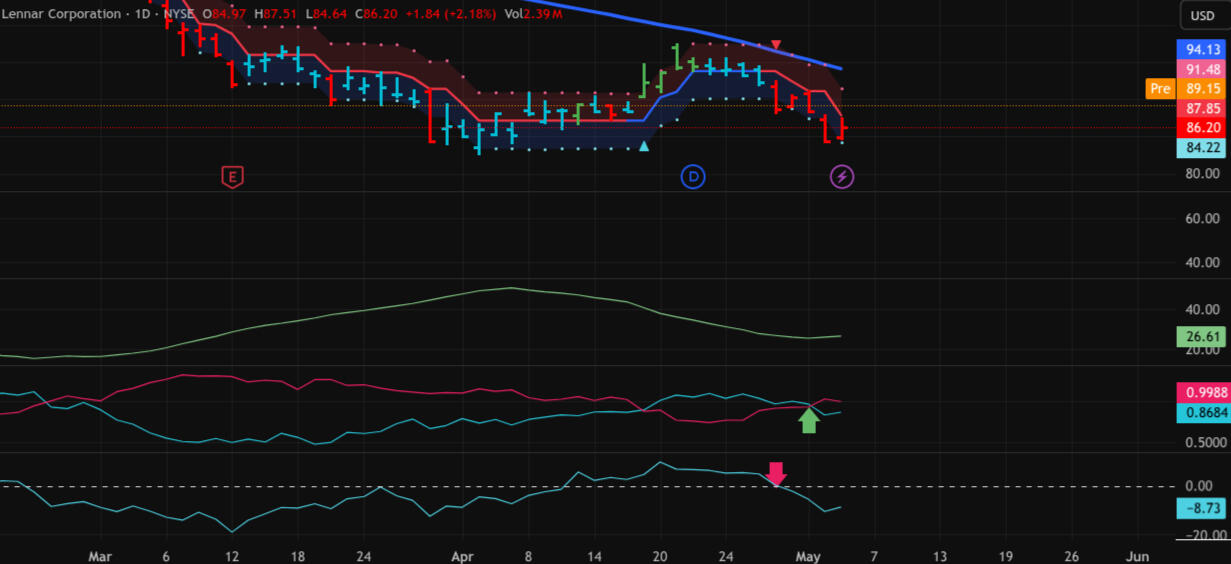
Just as I used a custom block-and-tackle system to manage those 400 lb. plaster panels, I now use a specialized suite of tools on Trading View. I’ve replaced manual searching with four custom screeners, several watchlists, and half a dozen charting templates, each designed to identify a specific type of market "structure."Case Study: Shorting the 2026 Homebuilders (LEN & KBH)In 2007, I was buying the 50 SMA. Today, I am using it as a "Ceiling of Resistance." In May of 2026, my system identified a high-probability short entry in the homebuilder sector, specifically Lennar (LEN) and KB Homes (KBH).
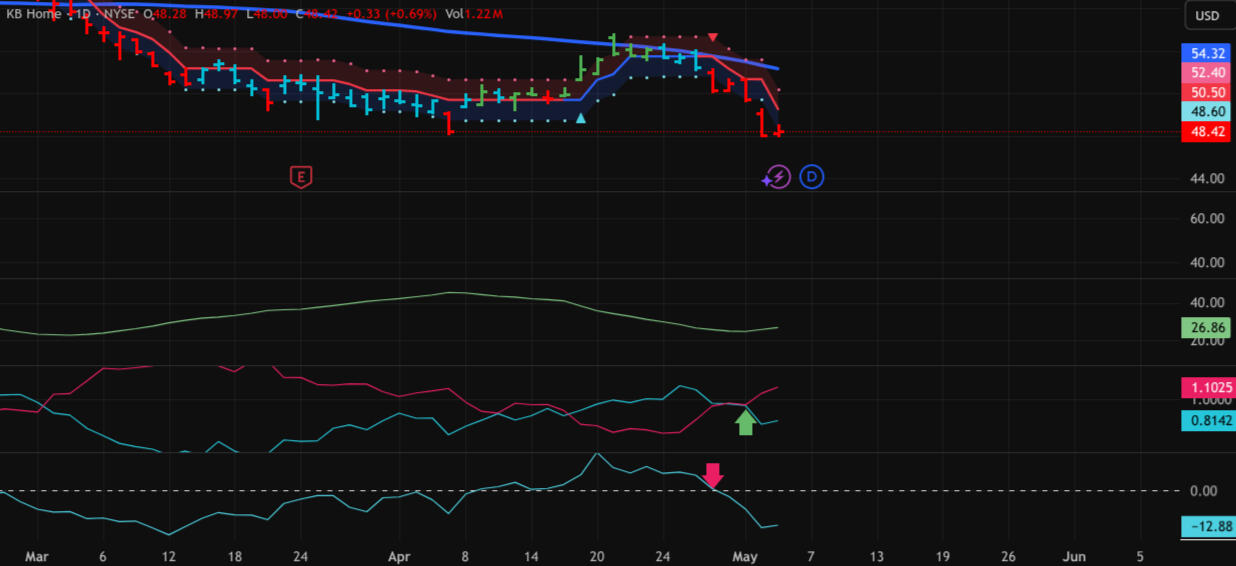
Success in these trades isn't based on a "hunch"—it is a result of Confluence. Here is the 5-point checklist I used to enter KBH at today's close:
The 50 SMA Fail: Price rallied into the 50-day Simple Moving Average but lacked the "buying power" to break through. This indicated that institutions were using the rally to sell their positions. Half Trend Confirmation: The price closed decisively below the Red Half Trend line, signaling that the immediate trend had shifted from bullish to bearish. 9-Period ROC (Rate of Change): The ROC closed below the zero line and is trending lower, confirming that the "velocity" of the move is now in favor of the bears.
The ADX Filter: With an ADX > 20, the market isn't just drifting; it is entering a "Trending Phase."
The Vortex Cross: The Red Vortex line crossed above the Blue Positive line, a definitive signal that downward momentum has overtaken the bulls.Precision Over PredictionMy current short in LEN is already up +5.3% in just three days. By using a few tools to define my "walls," I know exactly where my risk lies. Much like that $8 million master bathroom, a trading account is a delicate structure. One "heavy panel" (a big loss) can ruin the entire project.
By combining the discipline of the 1% Risk Rule with the precision of modern indicators like the Half Trend and Vortex, I no longer have to wake up in a "cold sweat" over market volatility.
LEN / KBH
THE MOBILE MOMENTUM TRADER: MANAGING A PORTFOLIO FROM AN RV:THE MODERN MOUNTAIN MANAs I look over my life, I have always valued independence and self-reliance. Had I been born 200 years ago, I most likely would have been a mountain man. Those hardy, intrepid explorers, traders, and fur trappers played an important part during the westward expansion of our great nation during the 19th century. Not only were they instrumental in leading pioneers through rugged mountain passes to verdant, fertile valleys—establishing farming and ranching co-ops and communities—they often had to play the role of negotiator, ensuring the safety of the men, women, and children under their care as the wagon trains made their way through often hostile territory.These rugged individualists wore their freedom and safety on their sleeves. Matter-of-fact, no-nonsense, and sober-minded, they lived life on their terms and were the better for it. Their lifestyle caught my interest at the early age of grammar school, and to this day, I feel a common kinship with them.The only drastic difference is the mode of transportation. They mostly traveled by raft, canoe, pack mule, horse, or by foot. I travel in my "white chariot," a 2015 RAM C/V Tradesman (my R.V. of choice). She has ably taken me across the country to some 10 states in search of my own freedom and adventure. Instead of a pack horse to trot me along a mountain trail, I ride an "Iron Horse" in the form of my mountain bike, or a rugged pair of trail running shoes for a rendezvous on some remote forested path. Instead of a raft of logs or a birchbark canoe, I ply various waterways on my paddleboard. Whether it’s paddling on the wild Myakka River with the alligators in Florida, or the fast-paced rapids of the Colorado River outside Grand Junction, Colorado, I share the same thirst for adventure, travel, and freedom that my forebears did.TRADING AS THE ULTIMATE FREEDOM TOOLTrading the financial markets is the perfect compliment for the modern wayfarer. It encompasses very similar traits to our adventurous brethren of the past—such as disciplined, steely focus, the ability to make quick decisions and take action, knowing when to be patient, and pulling the plug quickly when all hell breaks loose.The mountain man lifestyle was not for the faint of heart and required a firm resolve, much like trading requires full commitment to the process here in the 21st century. The stock market does not suffer fools; neither did Carson, Bridger, Johnson, Lewis & Clark, or Colter. They took full responsibility for their decisions come what may and never played the blame game or made excuses. That’s living life free! No blaming, no excuses—just taking responsibility for your decisions and accepting the outcome, whether positive or negative. That is the case for a nomadic financial lifestyle too.So how do we incorporate trading while traveling with a proper mobile trading setup? Let’s explore.THE MOBILE TRADING SETUPThe first rule of a nomadic setup is: Keep it very simple and clutter-free. There is no need for multi-monitor setups that draw massive power and take up precious space.Quality Internet Connection: I pay for my own mobile hotspot connection through my smartphone. Verizon is my provider, as they have the best tower coverage coast-to-coast in the USA. Long gone are the days where one had to pull into a Starbucks, McDonald’s, Lowe’s, or Home Depot just to log into a very unprotected public internet connection.The Power Source: I have a 400-watt inverter that plugs into the cigarette lighter, connecting to the main automobile battery under the hood. It powers my smartphone, my Chromebook laptop, and any portable battery packs I need.Quality Brokerage: Use established firms like Schwab, Fidelity, TradeStation, or Interactive Brokers. Make sure they are governed by the SEC and FINRA. Avoid offshore brokerages with dubious regulatory practices.Much like a carpenter or auto mechanic who has an extensive amount of tools to fit the particular job at hand perfectly, the financial market trader must also equip themselves.STRATEGIES AND SYSTEMSAre you a trend trader or a mean reversion trader? Do you prefer breakouts coming out of established basing patterns like a Cup & Handle, Flat Base, or Double Bottom? Or do you prefer trading pullbacks within a trend?Because the modern-day markets are always in flux, if you trade all year round, you will need more than a couple of strategies to match the overall market moods and swings as it rotates through its natural cycles. You will want to incorporate both mechanical and discretionary rules to establish entry, stop loss, and potential profit exits—but keep them very simple.THE GOLDEN GOOSEIf your goal is to trade full-time for the next 10, 20, or 40 years, the most important rule is to adopt the 1% risk rule per your account size and stick to it religiously. This is the "Golden Goose" of longevity. By never risking more than 1% of your total capital on a single trade, you ensure that even a string of losses cannot take you out of the game.MARKET INTERNALS AND SENTIMENTLater in the evening, I check for market internals to gauge the health of the overall trend. Two symbols provide excellent data for identifying market extremes that lead to reversals in the S&P 500:The Call/Put Ratio ($CPC): I look at the 10-day Simple Moving Average (SMA).If the 10-day SMA reaches an extreme of 1.00 or higher, the market is extremely oversold, often leading to a rally off the bottom.If the 10-day SMA reaches an extreme of 0.80 or lower, the market is extremely overbought, leading to a sell-off and lower prices.The Arms Index ($TRIN):If the 1-day SMA of the TRIN is at or above 2.0, I will be better off not placing a sell entry, as chances are great the stock will rally.If the 1-day SMA of the TRIN is at 0.50 or lower, a sell-off to the downside is likely.Keeping tabs with these two indicators can help prevent unpleasant surprises. If my scans show a "perfect" entry setup, but the market internals are at overbought/ oversold extremes, I wait for a better environment.AT-A-GLANCE TOOLS FOR THE NOMADIC TRADERWhen you are on the road, you need tools that give you the "big picture" quickly:FINVIZ Market Heat Map: This provides a color-coded guide of the 11 S&P 500 sectors and heavier weighted assets. It shows you instantly whether the day was overall Green (Bullish) or Red (Bearish). It also gives you the percentage of stocks above or below their respective 50 and 200 SMAs, which is a great overall indicator of market health.CNN Business Fear & Greed Index: This uses seven sentiment gauges to rank the market from Extreme Fear to Extreme Greed. Extreme readings in either direction often lead to bullish or bearish reversals. It is a fantastic tool for depicting the overall sentiment of all market participants.TAKING RESPONSIBILITYIn reality, trading directly from your vehicle is no different than a room or office in a primary residence. My routine is to run through my watchlists or screeners at the end of the day, utilizing a charting template that I have confidence in for the current market climate. I will place a trade long or short depending on the stock futures and overall market trend, entering all the data specifically in my spiral notebook.This lifestyle is about more than just money; it’s about the freedom to choose your own path, just like the mountain men of the 1800s. By combining modern technology with disciplined risk management, you can hunt for momentum from anywhere the road takes you.
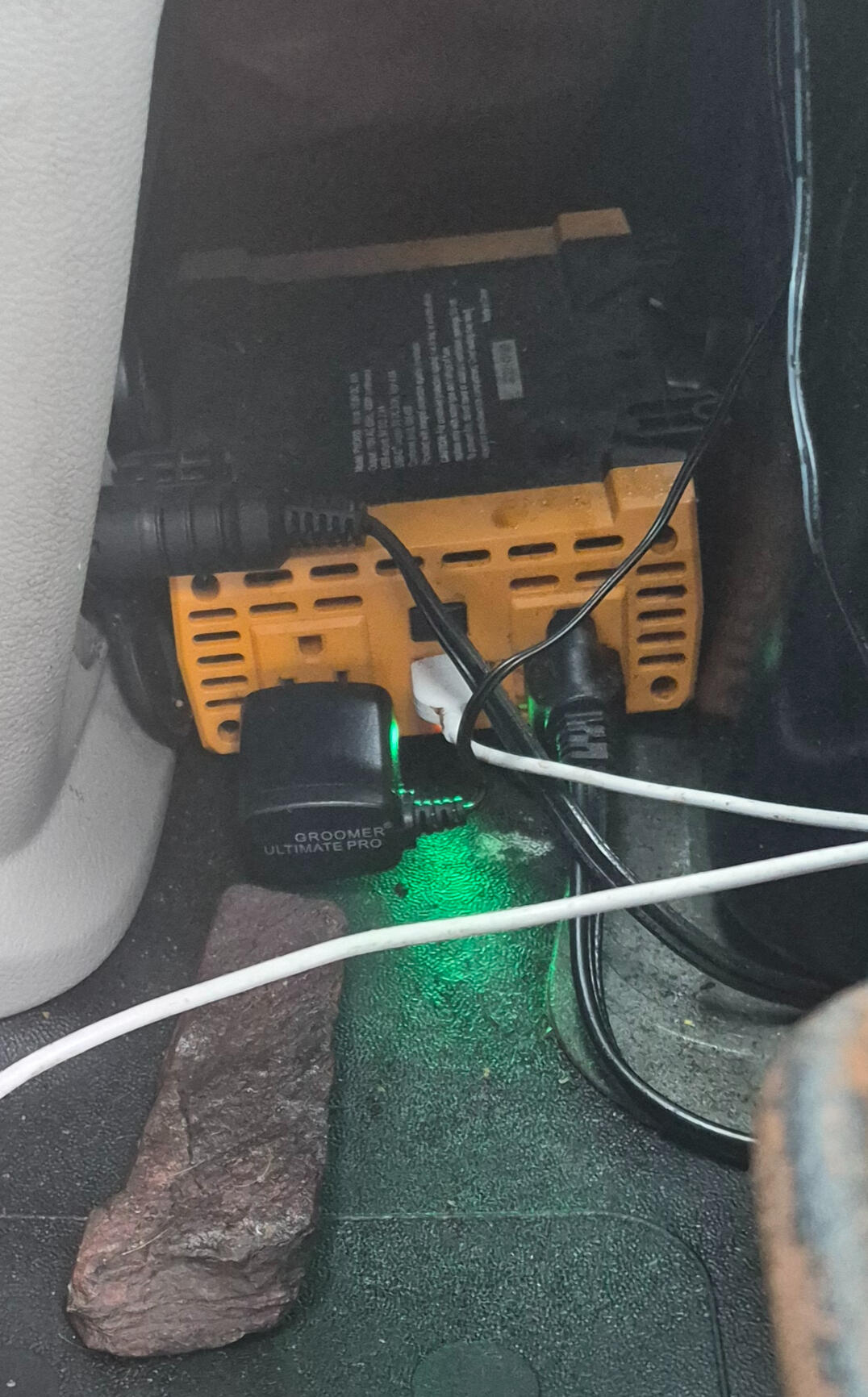
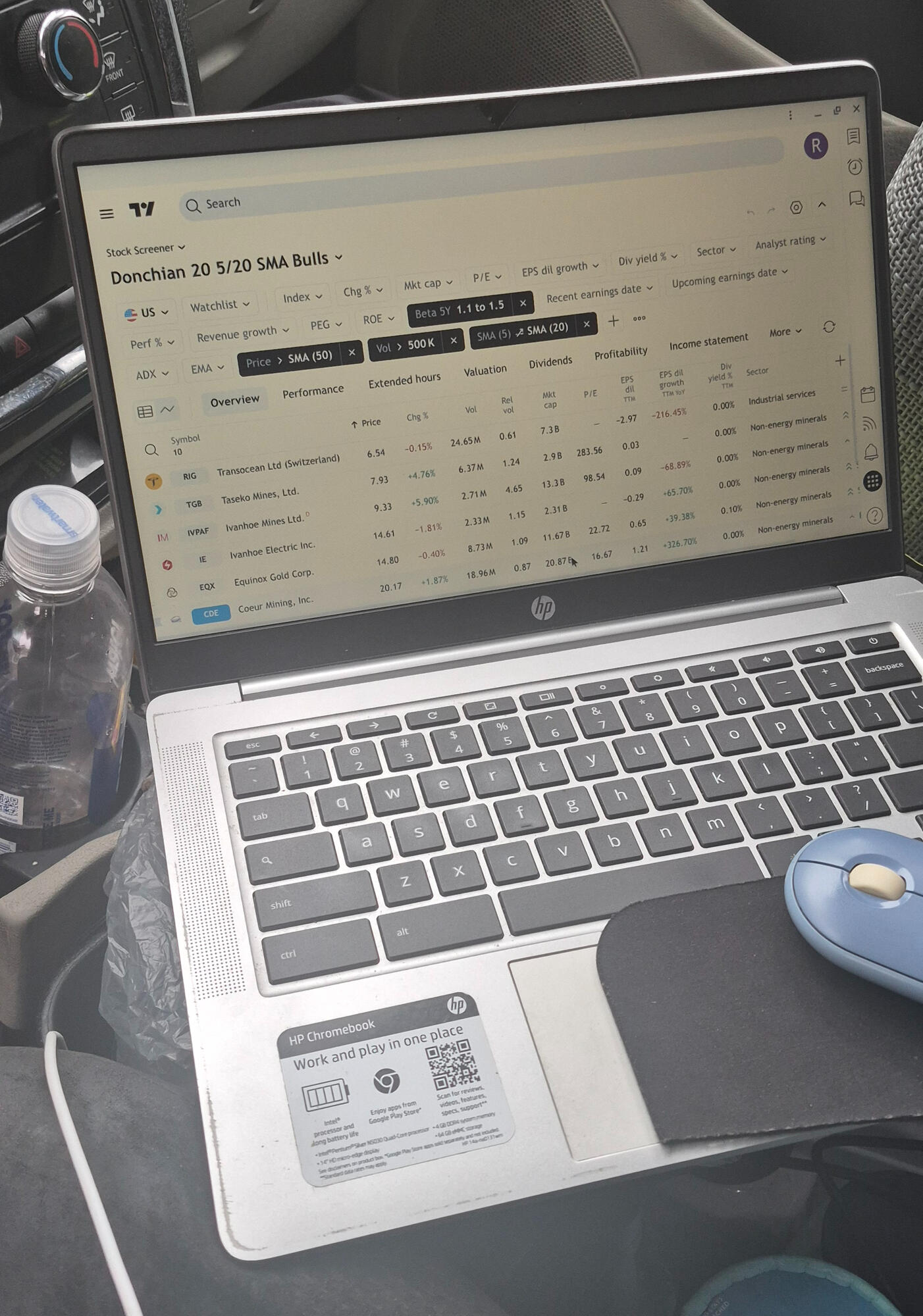
Photo of my 400 watt inverter. Laptop sits across the center console.
{This page contains affiliate links. If you purchase through these links, I may earn a small commission at no extra cost to you. As an Associate, I earn from qualifying purchases}. Check out below:
Legal disclaimer: Momentum Hunter LLC provides educational tools for informational purposes only. Trading involves significant risk. Always consult a professional. Past performance is not indicative of future results. Hypothetical or simulated performance results have certain inherent limitations. Unlike an actual performance record, simulated results do not represent actual trading. No representation is being made that any account will or is likely to achieve profits or losses similar to those shown.
Privacy Policy
Momentum Hunter LLC respects your privacy. We only collect information you voluntarily provide via email to contact us. We do not sell, trade, or share your personal information with third parties. This site does not use tracking cookies.